Sunday, November 24, 2013

The Nostalgia of the Infinite

The Nostalgia of the Infinite by Giorgio de Chirico is the most famous example of the tower theme which appears in many of de Chirico’s works. Nostalgia implies a never ending landscape despite being confined to a narrow canvas and employing only sparse, simple elements. De Chirico does a masterful job invoking infinity by creating a vision that feels like it extends far beyond the corners of the canvas. He uses several techniques to create this illusion:

Scale: the human figures are swallowed up by the environment. They are ants compared to the tower. The arched building in foreground looms even larger--note its size relative to the human figures. Even their shadows overwhelm them.

Shadows: The arched building in the foreground casts a crisp shadow covering nearly the bottom third of the painting. Its shape and scale suggests that the arch is not a mere freestanding structure but part of a much bigger building that we are only seeing a corner of. Also note that behind the arch we can see a shadow suggesting a third structure to the right of the frame.

Perspective: the dramatic perspective in Nostalgia is impossible. It is wrong but it is wrong in a specific way: the perspective mimics what we see from a moving train. The horizontal axis has been truncated, leading to dramatic perspective shifts as we move from left to right. We are seeing only a brief glimpse of this tower as we pass through a bigger journey.

Time: The architecture invokes antiquity. The plain walls, the columns and arches all harken back to the past. However the fresh flags and human visitors suggest that this scene is not an ancient ruin but a living site. This landscape extends forward and backward in time, beyond the moment we are seeing it in.

Mystery: The composition of Nostalgia is simultaneously simple and perplexing. It resembles a lighthouse on dry land. It is situated in the middle of a desert. Whatever purpose the building serves, it cannot be glimpsed through its few, spare windows. Furthermore, de Chirico makes subtle use of surrealist elements. The tower casts no shadow.  Five flags mark its four corners. The sky is a shade of bluish green that is not quite impossible, but entirely unlikely. These elements suggest that this landscapes hold secrets beyond what meets the eye.

‘Sometimes the horizon is defined by a wall behind which rises the noise of a disappearing train. The whole nostalgia of the infinite is revealed to us behind the geometrical precision of the square. We experience the most unforgettable movements when certain aspects of the world whose existence we completely ignore, suddenly confront us with the revelation of mysteries lying all the time within our reach and which we cannot see because we are too short-sighted, and cannot feel because our senses are inadequately developed. Their dead voices speak to us from near-by, but they sound like voices from another planet.’ - Giorgio de Chirico

Stray notes:

Wednesday, February 8, 2012

The Evolution of Information

(Post is largely inspired by http://goo.gl/orOPV , a lecture by David Weinberger.]

Many species utilize communication, but none has achieved success in it quite like humans. Vocal and visual signals are used to communicate information by many species, from birds to mammals, and other species use pheromones or chemical means of communication. But humans are unique in that they've developed language. Language allows us to communicate information in far greater depth and breadth than other such means found elsewhere in nature. I can't say for sure, but I think it's safe to say that verbal communication, probably our first medium of language, has initiated our species' digression from the rest of nature. Aside from our unique physical features (many of which actually leave us maladapted to survival), our capacity to communicate is a distinct natural feature that has made us the dominant species on Earth.

Means of communication have underwent several phases. Language enables us to share the mental impressions, concepts, ideas, or abstractions--that is, information. It was first employed (or, first employed well), presumably, through the use of voice. However, this suffered from the limitations inherent therein. Voice is limited in that sounds are transient and reach only those within certain proximity. With voice, the dissemination and preservation of information is wholly dependent on the memory of minds and the bodies that that carry them. Information was thus subject to the follies of mind and body.

Humans then developed written language. It may have first been by inscriptions on cave walls, on stones, leaves, or scrolls. This greatly expanded the limitations of language from when it's sole medium was voice. With written language, information got permanence. But it was still subject to the proximity limitations inherent in the medium; only those within proximity of these physical media could benefit from the information (e.g., stone tablets). It was probably difficult to "write" or inscribe language onto media, and thus still bound by the difficulty to communicate or distribute information in this manner.

Paper is arguably the greatest invention for the furtherance of language and its power as a tool to communicate information. Paper is lightweight and it is easy to inscribe information onto.  Tons of books were created, but it was not SO easy to inscribe so as to render mass production feasible. This made duplication troublesome, meaning the dissemination of information was bound by these limitations.

Think about how, at each of these critical shifts in the methods information was stored and transmitted, the technologies have transformed how humans live. We don't know much about what happened before written language, given that verbal information is quick to dissipate. But with the invention of written language came the birth of history, which allow us to look back and see the consequence of these technologies. I think these technologies let knowledge grow, which I consider to be information synthesized or processed by our understanding so as to be useful. Written language has greatly promoted science, math, art; I don't think I'm being hyperbolic when I say that books have allowed the human species to go beyond this planet. Books have helped knowledge to persist and pass from generation to generation. The printing press has made this knowledge available to the masses, and has been a necessary component in all the things modern society enjoys.

Still, with books, we had to go to the library or bookstore, find the book with the information we're looking for, and obtain it. Then, if we needed more information, we needed to go back to get another book. If the library or bookstore didn't carry the book with the information you want, you were out of luck. If nobody wrote/published/distributed a book that had the information you wanted, you were out of luck. If the INFORMATION wasn't worthy of the funds to publish and distribute books (another limitation is that physical media is relatively expensive), that information never reached the minds that might have enjoyed it. Basically, it is time consuming work and you can only get as much information as books you can obtain. The physical limitations of books as means of communicating information is apparent.

I think we're at another critical moment in the evolution of information. We've finally invented a medium of language that subverts the problems of proximity and transience. We have the Internet (telecommunications in the past solved the problem of proximity--telephones and telegraph and radio and whatnot--but were transient). Information is no longer carried by a static medium but a dynamic one. It lives in the deliberate fluctuations of energy, constituting the bits that carry all of the information we could ever want. We now have the Internet through which we can access information in one physical location, without having to chase after books. Information has transcended the finite nature of paper media, and it is as infinite as information can be and readily accessible for the most spontaneous of inquiries (well not exactly all that accessible, but Google, Facebook, Wikipedia and so on are all working to help us easily find relevant information).

If the effects of language, written language, and paper are apparent to us, I think the implications of the Internet are nothing short of awesome. Knowledge has contributed to the creation of devices for its own proliferation--in that way, knowledge is self-serving--but we enjoy the collateral benefits. Books, radio, television, and the Internet are all such devices. Ultimately though, knowledge means nothing without us humans, but we humans owe our successes to information.

Truly, the adage "mind over matter" is appropriate when considering how information has empowered us. It's what helped us build shelter, fight disease, create order in society, and learn about the cosmos and beyond. I believe that the Internet, with the new powers it confers to information, will be the reason why future generations will consider humans of the 21st century as primitive creatures. And I believe such observations will be apt. I hope more people will respect this technology in light of the power of information, what it has done for our species, and what it can now do. I think it's important to understand what the Internet does, and we can't be shortsighted. The Internet isn't about technology companies or media companies. It isn't about social media companies or e-commerce companies. The Internet is about humanity, and the course of our fate has forever changed in the face of this invention.

TL;DR - Look what happened since the invention of paper as the medium for information. Think about what the Internet can do as a medium for information. Knowledge will take on new meaning.

Friday, June 10, 2011

Thursday, February 24, 2011

The beauty of Watson.

Watson has recently taken the spotlight by defeating two of the best Jeopardy! players around. The media is buzzing with predictions of a future before seen only in science fiction. Visions of Hal 9000, Vickie (from I, Robot), or even Data (Star Trek) have showered the press and the blogosphere. Certainly, Watson incites such science fiction imaginations. But I think Watson could have more profound implications in our immediate future. I've fallen behind on my reading, and while I can't say that I've seen all of the articles written about Watson, I have yet to come across the implication that, in my opinion, really qualifies Watson as an enormous leap in technology.

Put aside of what Watson was designed to do; that is, play Jeopardy!. Instead, think about how it does it and what it entails. Watson can parse natural language into the computational equivalent (see question 3 here). It can understand the dominant form of human communication and, with it, do whatever it is a computer does. The punchline, as it were, is this: Watson demonstrates the possibility of a new kind of interface with a computer. No longer do we need to know the language of computers in order to interact with them; instead, computers can understand our language. It (he) accepts input in the language on which we operate. And in doing so, it enables the possibility that computer literacy is equal to language proficiency. This shift in interaction, in my opinion, is what makes Watson so revolutionary.

Perhaps Watson is not yet ready to help us fully realize this idea. But for someone who doesn't quite understand the complicated algorithms involved in Watson's programming, I think this is fascinating and inspiring. By creating Watson, IBM has put in our reach what was before only imagined. The next step is to expand Watson's knowledge of words. Then porting this new interface to programs that already exist may be all that's required to expand its utility. I'm sure this process will not be easy, but what I've seen Watson do on Jeopardy! gives me hope that it's not impossible.

Monday, January 3, 2011

Thursday, December 30, 2010

The Gentle Genie


Monday, November 15, 2010

Friday, October 15, 2010

Saturday, October 9, 2010

Friday, October 1, 2010

Sunday, September 26, 2010

Friday, July 30, 2010

Descartology


Props to René Descartes for setting up the punchline. It was a big decision to focus on the host and not God following their split. Ultimately I thought it was better to advance the plot by sticking with the Host. It's also easier to get the lulz since God is a more serious character than the Host. Where did God go? What is he up to now?

Monday, July 19, 2010

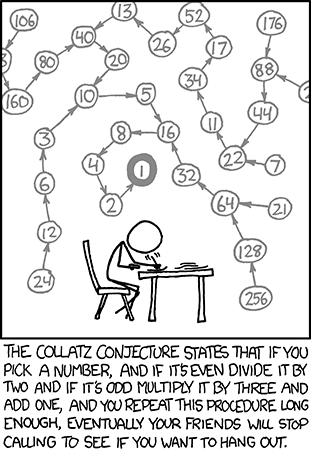
Collatz Conjecture

(from xkcd.com)

The Collatz conjecture was proposed by the German mathematician Lothar Collatz in 1937 and remains unsolved. The conjecture is as follows: start with any natural number, divide by 2 if it is even or else multiply it by 3 and add 1. If one takes the resulting number and recycles it as the input a certain number of times, one will eventually have an output of 1. Go ahead and try it with some small numbers (trying this manually with large initial numbers may require lots and lots of iterations, so choose carefully!).

What draws me to this particular conjecture is the simplicity in understanding it (which is good since, admittedly, I am by no means mathematically inclined). A few months ago, I spent the day reflecting on this conjecture and had a blast just thinking about it. While this is in all likelihood totally meaningless and irrelevant, I thought I'd share what I thought was curiously interesting found by working on the problem backwards.

If you look at the function of the conjecture ("half or triples plus one"), it's apparent that the iteration that yields an output of 1 will always be by halving the number--you can't triple a natural number and add 1 to get 1. Furthermore, it's apparent that for any number that will yield an output of 1 by continuously halving it will be a power of 2 (i.e., 2, 4, 8, 16, 32, etc.). Given this, we can safely say that once the output is ever a power of 2, the function will eventually yield an output of 1.

We know that if we are halving a number that is a power of 2, the resulting number will also be a power of 2. The question, then, is how this function yields an output that is a power of 2 from a number that isn't a power of 2. For this, we look at the "triple plus one" part of the function and how/when it will yield a number that is a power of 2. I began by looking at the first few numbers that are powers of 2 and tried to see if they were derivable by tripling a whole number and adding 1. I saw that, in a sequence of powers of 2, only every other number was derivable by tripling a whole number and adding 1 (e.g., 16=3(5)+1, 64=3(21)+1, 256=3(85)+1, etc.). The resulting numbers were all powers of 4--probably irrelevant but interesting, or at least I thought so.

I then decided to look at these numbers that yield a number that is a power of 4 by tripling and adding 1 to: 5, 21, 85, etc. While this is probably a big stretch, I decided to see what these numbers looked like in their binary form, as I felt that the "power of 2" element was related to how numbers are represented in binary form (see this Wiki page on numerical representations in binary). Here's a short list of the numbers that, by tripling and adding 1 to, will yield a number that is a power of 4 in both their decimal and binary representations:
Dec BinaryBinary after 3x+1
11100
510110000
21101011000000
851010101100000000
34110101010110000000000

And this pattern continues which I thought was interesting. What the pattern reveals is that, if one continues the sequence in the table above, the following number is always the preceding number plus the next power of 4 in the binary. Perhaps that last statement isn't too clear and so I'll try to illustrate my point here:
In binary, "101" can be translated into decimal as "4+0+1", and "10101" as "16+0+4+0+1", and so on. So, 341, which in binary is 101010101, can be translated into "256+0+64+0+16+0+4+0+1". [Green text will represent 341]. The next number in the sequence will be, then, be the translated "...0+1" with "[next power of 4]+" inserted into the beginning (e.g., 1365 in binary is 10101010101 which can be translated as "1024+0+256+0+64+0+16+0+4+0+1", or simply the translated binary of 341 with "the next power of four" added to it--that is, 256*4=1024).

If I remember correctly, a cursory glance at this showed me that only the numbers in the sequence outlined in the table above will yield a number that is a power of 4 by tripling and adding 1. I stopped thinking about the problem here mainly because I got tired but I recall tinkering a bit with division, multiplication, and addition in binary and not being able to find a significant pattern.

Of course, the difficult part of this conjecture is how understanding even numbers that are not powers of 2 eventually yield a number that is a power of 4 by the "halve or triple plus one" function as a whole, and not just by considering either part of the function independently. Also, resorting to binary was probably totally unnecessary, but being not at all mathematically adept, it helped me to better think in a domain of base 2.

Tuesday, June 29, 2010

Friday, June 18, 2010

Lady GaGod


The dress texture is a real Lady Gaga dress. The lighting bolt under the right eye is originally associated with David Bowie but Lady Gaga co-opted it for the "Just Dance" video. I also couldn't resist associating God with the lightning bolt, which we've seen him use already.

Monday, June 14, 2010

Zoology


The host has discovered that he can manipulate God's avatar. It's operating principle lets the beholder call the shots. This gives the host a power over God he is quick to exploit. God's temper is showing as he verbally rebuffs the host. A showdown is looming.

Wednesday, June 9, 2010

Godpher


This strip explores the nature of God's avatar. The way it operates allows the perceiver to call the shots. God appearing as gopher was originally conceived for a retelling of the flood story. God would go back and shepard each animal to the Ark. The storyline was scrapped because it deviated too far from the strip's format.

Monday, June 7, 2010

Illusionism

Illusionism is a metaphysical theory that there is no such thing as free will but that we should not let people know that this is the case. Illusionists argue that there would be dire consequences for society if people were come to think that free will does not exist, but in some cases these illusions may affect the normal functioning of a man's life. Illusions make a man a "pure thinker", which not only affects his life, but he himself forgets about his creation.

Illusionism suggests that blame and morality are artificial but nonetheless useful as incentives and deterrents. Even though men cannot be held culpable, they can nonetheless be guided towards certain conduct and away from others. For instance, police can effectively deter crimes by threatening to punish people who commit them. In fact, the law can serve three purposes without implicating moral concerns: rehabilitation, incapacitation and deterrence. Illusionism has much in common with utilitarianism, as it suggests that morality and the concept of 'free will' are useful to improve the general welfare of man--even if somewhat disingenuous.


Wednesday, June 2, 2010

Thursday, May 27, 2010

LOST Explained

Now that LOST has concluded its six season run, we are left with nearly as many unanswered questions as we started with. The final episode promised a ‘big reveal’ but didn’t deliver one as thorough as many fans would have liked. Nonetheless, Christian Shephard’s speech in the final ten minutes was as close as we will get—and with it we can reason backwards to explain many, if not all, of the mysteries of LOST. Christian’s speech was one of those rare moments of revelation on LOST and will be considered truthful in its entirety. As we know, the characters on LOST are frequently dishonest or misinformed when they explain events—so to the extent that anything they have said conflicts with Christian’s speech (either explicitly or implicitly), Christian’s speech will control. Other character’s statements can be used to expand and explain it but never contradict it.

So what exactly did Christian tell us? (1) The afterlife exists and (2) Jack’s life and the people in the church were real. The Island could have been explained scientifically, or as a dream, or as an illusion perpetrated by a tiny slug—but Christian told us that at the core of the mystery was the afterlife. You could argue this only explains the sideways timeline universe, but if the sideways timeline universe has no bearing on the main universe—why show it at all? The main timeline also regularly depicts life after death in the forms of countless ghosts and whispers who talk to the characters.

How exactly does the afterlife work in the LOST universe? The line between real world and the afterlife is blurred, if not non-existent. A place that seems real can be supernatural (see: the sideways timeline) or a place that seems supernatural can be real (the island). Death is a gradual process—souls transition from reality to an illusion thereof to heaven. They don't always move forwards and different people take different routes. The Island is an early step towards death, and roughly akin to purgatory. What the island does, like purgatory, is keep people from returning to their old life or moving on to the next one. We’ve seen how it keeps them from leaving in countless ways: it conceals its location; it prevents ships from sailing out, etc. And even if someone does escape (like the Oceanic Six) it will call them back--like a moth to a flame, Jack and Michael and Locke cannot resist being drawn back to the island even after they 'escape' it. The only people it lets come and go are the ones it knows will return (see Jacob, Ben, Richard).

How does the island prevent people from moving to the next life? It keeps their flesh alive. It heals the infirm (see Rose’s cancer). It can revive the dead (See Sayid). It keeps people from aging (see Jacob & Richard). It provides food and water (see the DHARMA drops and Christian leading Jack to water). And if people aren’t cooperating, it prevents them from committing suicide (See Jack, Richard, Locke, etc.). Despite many people referring to the island’s “rules” (like those governing the Ben/Widmore or Jacob/Smokey conflict), the only rule that seems to be inviolable and independently enforced is the prohibition on suicide.

But most of all, the island provides distractions—it manufactures conflicts and mysteries to keep people attached to their mortal lives. All the polar bears, buttons to press, magic numbers or huge birds that screech “HURLEY,” are simply there to divert people’s attention like a magician’s slight of hand. The stakes are often high (pressing the button and fighting Smokey were to “prevent the destruction of the world”), although it’s unlikely the Island could deliver on its threats. But the island will say whatever is needed to keep people on it, engaged in its drama. Perhaps this is most evident in some of its longest residents. The island kept Jacob busy for two millennia as a ‘guardian’ before he passed on. It kept Desmond in the Swan pressing a button for three years. Who knows how long it kept Hurley and Ben there? The island can trap people in more direct ways too: like the Smoke Monster, who could neither die nor leave, and Michael, whose soul is “stuck on the island.” Despite Jacob and the Smoke Monster being seen as the highest authorities on the island, they are just some of its victims.

I will go a step further and say that I do not believe that the Losties died on Oceanic 815. Although the island is where the dead go, the living can go there too. Like Orpheus traveling to the Underworld to see his deceased wife Eurydice, the land of the dead is not necessarily closed to the living. This is supported by Christian’s statement that all the people in the church were real and with each other during the most important time in their lives. If the Losties did not survive Oceanic 815, they would have never met Desmond, Penny & Ben--who were in the church. However, this point is immaterial as the bulk of the theory works either way.